
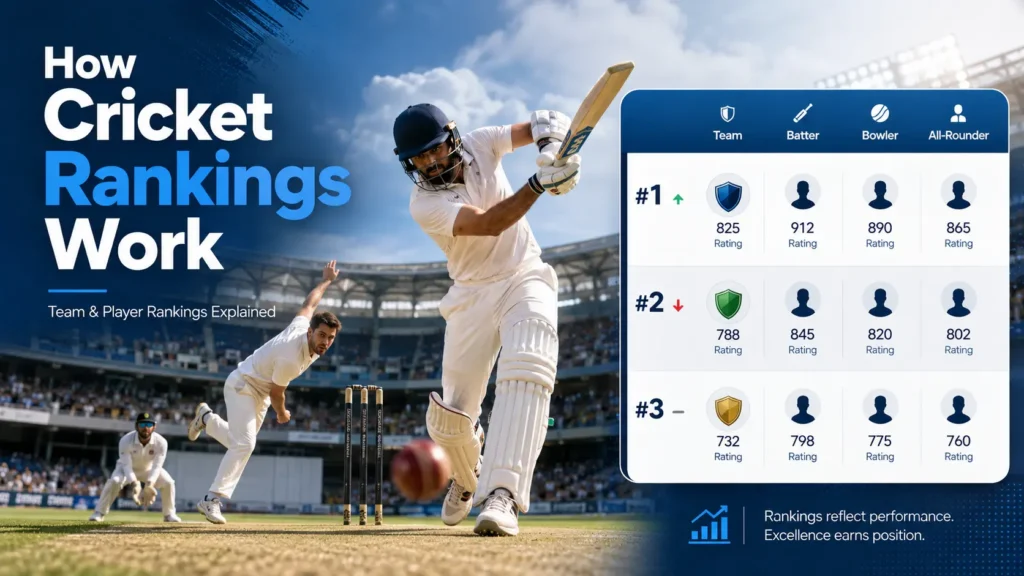
Cricket rankings are one of the easiest ways to compare the performance of international teams and players, but the system behind those rankings is often misunderstood. A team can win a series and still remain below another side, while a batter or bowler can move up or down the rankings even when their recent statistics appear similar.
The ICC cricket rankings use a points-based rating system to evaluate teams and individual players across Test, ODI and T20I cricket. Team rankings consider results and the relative strength of opponents, while player rankings use a sophisticated moving-average system that gives greater importance to recent performances. Players are rated on a scale of up to 1,000 points.
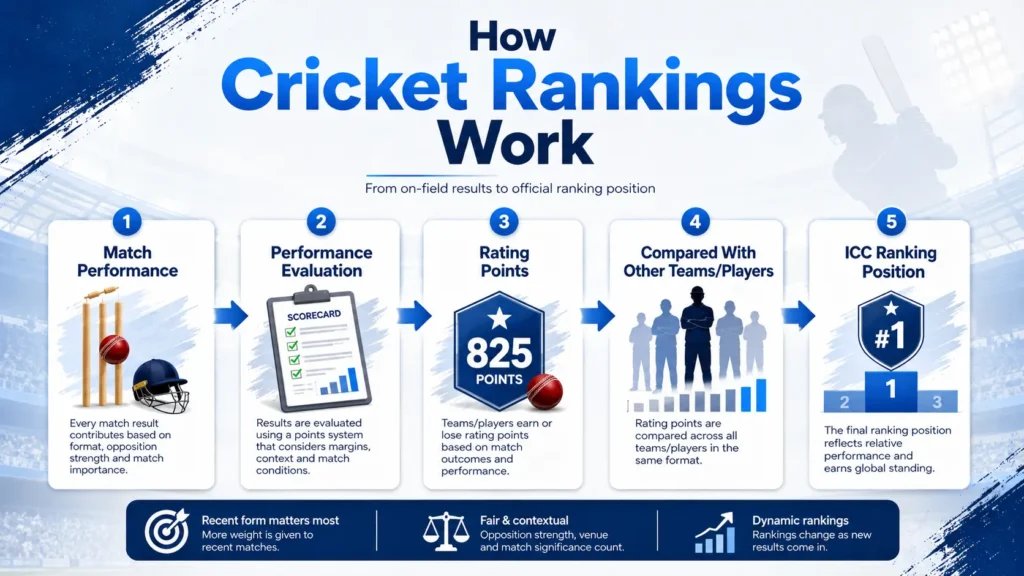
In this guide, we explain how ICC cricket rankings work, how team and player rating points are calculated, what affects batting, bowling and all-rounder rankings, why rankings change, and the difference between a player’s ranking position and rating points.
By the end, you will have a clear understanding of how the ICC determines which teams and players sit at the top of world cricket.
Quick Answer: How Do ICC Cricket Rankings Work?
The International Cricket Council (ICC) rankings compare international cricket teams and players using performance-based rating systems.
There are separate rankings for:
- Test cricket
- One Day Internationals (ODIs)
- Twenty20 Internationals (T20Is)
- Batters
- Bowlers
- All-rounders
- Men’s and women’s international cricket
Team rankings are based on points earned from international results, adjusted by factors including the relative strength of the opposition. A team’s rating is derived from its accumulated points relative to the matches or series included in the calculation. Player rankings work differently. ICC describes them as a sophisticated moving-average system in which performances generate rating points on a scale from 0 to 1,000. Recent performances carry more significance than older ones, although the rankings are not simply a short-term form table.
What Are ICC Cricket Rankings?
ICC rankings are official performance tables maintained by the International Cricket Council to compare international teams and players.
An important distinction is:
Ranking = position in the table
Rating = number of points behind that position
For example, a batter may have a rating of 820 points and be ranked No. 2. Another batter with 850 rating points may occupy the No. 1 position.
ICC specifically uses the term ranking for a player’s position and rating for their points.This distinction is important because a player’s rating can rise or fall without necessarily changing their ranking if the players around them also change.
How ICC Team Rankings Work
ICC maintains separate team-ranking systems for the different international formats.
For men’s cricket, this includes:
- ICC Test Team Rankings
- ICC ODI Team Rankings
- ICC T20I Team Rankings
Women’s international cricket has ODI and T20I team rankings.
The system was developed by statistician David Kendix. ICC describes the calculation in a way similar to a batting average: teams accumulate ranking points, and those points are divided by the relevant match or series total to produce a rating rounded to the nearest whole number.
Basic ICC Team Ranking Formula
At a simplified level:
Team Rating = Ranking Points ÷ Relevant Match/Series Total
The team with the higher resulting rating appears higher in the rankings.
However, this does not mean that every victory is worth exactly the same number of points. The relative strength of the opponent matters.
Does Beating a Stronger Cricket Team Give More Ranking Value?
Generally, yes.
A result against a highly rated opponent has greater ranking significance than the same result against a substantially weaker opponent.
This is one reason a lower-ranked team can make meaningful ranking progress by defeating a much stronger international side.
Likewise, a highly rated team is expected to perform well against weaker opposition, so defeating a much lower-ranked side usually produces less movement than beating a close or stronger rival.The rating system is therefore designed to measure quality of results as well as results themselves, rather than simply counting wins.
Does Margin of Victory Affect ICC Team Rankings?
Team rankings should not be confused with tournament points tables or net run rate.
The core ICC team-rating system focuses on match or series results and the relative ratings of the competing teams rather than simply rewarding a side because it won by an unusually large margin.
This means a 100-run victory does not automatically provide a proportionally larger ranking reward than a five-run victory.
That distinction is important when comparing:
- ICC rankings
- World Cup points tables
- World Test Championship standings
- Net run rate
- Tournament qualification tables
They are separate systems serving different purposes.
How Recent Matches Affect ICC Team Rankings
ICC does not allow very old results to retain the same influence forever.
The rankings undergo an annual update around May.
For example, in its May 2026 annual updates, ICC stated that matches played since May 2025 were weighted at 100%, while matches from the preceding two years were weighted at 50%.
This structure prevents historic results from permanently determining a team’s current position.
Why does this matter?
Imagine a team was dominant three years ago but has declined significantly.
If every old match carried equal value forever, its ranking could remain artificially high.
Recency weighting allows the rankings to better reflect the team’s current competitive level.
How ICC Player Rankings Work
Player rankings are more complicated than team rankings.
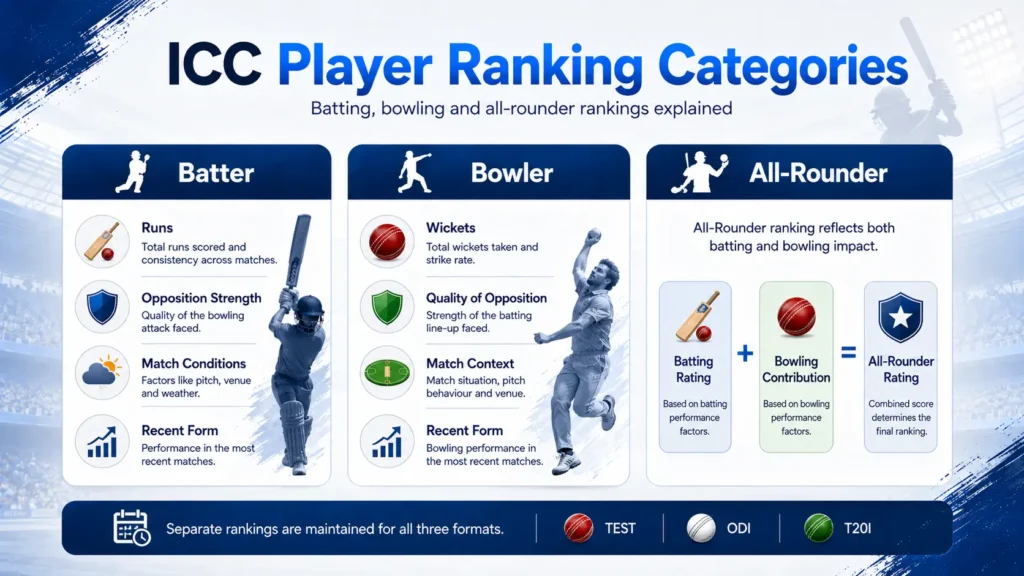
ICC publishes separate rankings for:
Batters
Measures batting performance within the relevant format.
Bowlers
Measures bowling performance.
All-rounders
Combines batting and bowling ratings into an all-rounder index.
Each format has its own rankings because success in Test cricket does not necessarily translate directly to ODI or T20I cricket.
A player can therefore simultaneously be:
- No. 2 in Test batting
- No. 15 in ODI batting
- outside the top 50 in T20I batting
without any contradiction.
How Are ICC Player Ranking Points Calculated?
ICC player ratings operate on a scale from 0 to 1,000 points.
The system uses a sophisticated moving average based on individual match performances. When a player’s performances improve relative to their established record, their rating tends to rise. When performance declines, their rating can fall.
The complete proprietary weighting formula is not publicly published.
ICC does confirm, however, that the calculations are performed automatically using predetermined algorithms and that there is no subjective human assessment involved in assigning the performance value.This distinction matters because some explanations online present an apparently precise public formula for player rankings when ICC itself describes a more sophisticated algorithm.
Factors That Influence ICC Batting Rankings
Batting rankings involve more than simply counting total runs.
The ranking system considers the context of a performance.
Important factors include:
1. Runs Scored
Scoring more runs generally creates the opportunity to gain more rating points.
But 100 runs in every match are not necessarily treated identically.
2. Strength of the Opposition
Performing successfully against highly rated opponents can carry greater value.
ICC confirms that opposition strength is factored into its player-rating framework.
3. Match Conditions
The system uses scorecard information to evaluate how easy or difficult run-scoring was.
ICC provides a useful example: when both teams score around 500, the algorithm interprets the match as relatively favourable for batting. When both teams score around 150, runs are considered harder to obtain, making an outstanding batting performance more valuable.
4. Match Context and Result
The wider match situation can also influence the value assigned to the performance.
5. Previous Rating
ICC rankings use a moving-average approach.
One exceptional innings therefore does not necessarily transform an established player’s rating overnight.
Consistency matters.
Does ICC Have Experts Rating Cricket Pitches?
No.
This is one of the most common misconceptions surrounding ICC player rankings.
There is no panel manually deciding that a particular pitch deserves a certain ranking value.
ICC states that ranking calculations use information contained in the match scorecard.
For example:
- If scoring is generally very high, conditions are interpreted as easier for batting.
- If most batters struggle to score, successful batting performances can receive greater recognition.
The process is algorithmic rather than based on an expert manually entering a “pitch difficulty score.”
How ICC Bowling Rankings Work
ICC bowling rankings evaluate a bowler’s international performances within each format.
Important factors can include:
- Wickets taken
- Runs conceded
- Quality of opposition
- Quality of batters dismissed
- Match circumstances
- Overall performance conditions
- Recent performances
Taking the wicket of a highly rated batter can be more valuable than dismissing a much lower-rated player because the rankings account for the quality of opposition.
Like batting rankings, bowling rankings operate as a moving performance measure rather than a simple career-wicket leaderboard. This explains why the bowler with the most career wickets is not automatically ranked No. 1.
How ICC All-Rounder Rankings Are Calculated
Unlike much of the player-ranking algorithm, ICC publicly explains the core calculation for the all-rounder index.
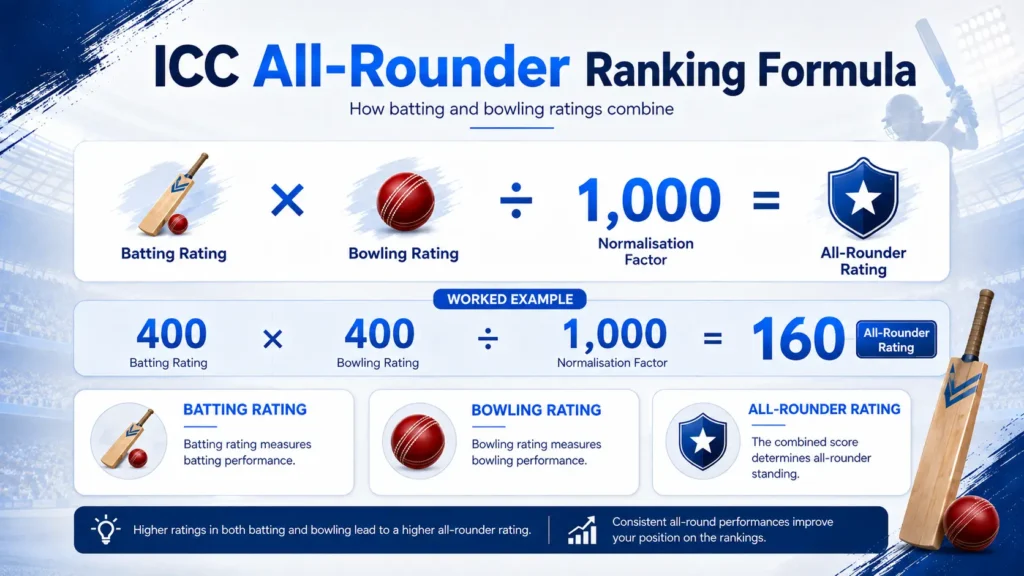
The formula is:
All-Rounder Rating = Batting Rating × Bowling Rating ÷ 1,000
ICC gives the example of a player with:
- Batting rating: 400
- Bowling rating: 400
The calculation becomes:
400 × 400 ÷ 1,000 = 160
That player’s all-rounder rating would therefore be 160 points.
This method also prevents a specialist batter who barely bowls from automatically appearing high in the all-rounder rankings.
For example:
800 batting × 0 bowling ÷ 1,000 = 0
Despite being an elite batter, that player would have no meaningful all-rounder rating.ICC considers an all-rounder index above 300 to represent world-class territory.
What Is a Good ICC Player Rating?
ICC provides useful benchmarks for understanding rating points.
| ICC Rating | General Interpretation |
| 900+ | Exceptional or supreme level |
| 750+ | Usually competitive with the world’s leading players |
| 500+ | Strong, solid international rating |
ICC notes that exceeding 900 rating points is a rare achievement, while approximately 750 or more is normally sufficient to challenge for a place among the world’s leading players.
These numbers should nevertheless be understood within each format and ranking category.An 800 batting rating and an 800 bowling rating are not direct measurements of the same skill.
Why Can a Player’s Ranking Fall Without Playing?
This question causes considerable confusion among cricket fans.
ICC rankings are relative.
A player’s position can therefore change because:
- another player performs exceptionally well;
- the player becomes inactive;
- previous performances lose influence;
- eligibility or qualifying-period rules apply;
- other players accumulate higher ratings.
ICC says players generally need to have appeared within a qualifying period to remain in the published rankings. It gives approximate qualifying windows of 12-15 months for Tests and 9-12 months for ODIs and T20Is, although circumstances can vary.Retired players are removed from the relevant rankings.
What Happens If a Batter Does Not Bat?
A batter’s rating is normally unchanged if they play a match but do not actually bat.
ICC explains that players should not be penalised when they had no opportunity to perform for example, because a match situation or rain meant their innings was never required.
Bowling works slightly differently.A bowler who does not bowl may sometimes lose points when the opposition makes a large total, although ICC says a bowler who is unused when the opposition is dismissed for fewer than 150 is not penalised.
When Are ICC Player Rankings Updated?
ICC moved to a regular weekly player-ranking update system in 2021.
According to ICC:
- Women’s ODI and T20I player rankings: updated on Tuesdays.
- Men’s Test, ODI and T20I player rankings: updated on Wednesdays.
The updates include eligible matches completed before the update day.
Team rankings have a different schedule.
ICC says they are updated:
- after each Test series;
- after ODIs;
- after T20Is;
with an additional annual ranking update around May.
ICC Rankings vs ICC Rating Points
Understanding this distinction makes the entire ranking system easier to follow.
Suppose three batters have:
| Player | Rating | Ranking |
| Player A | 850 | 1 |
| Player B | 830 | 2 |
| Player C | 790 | 3 |
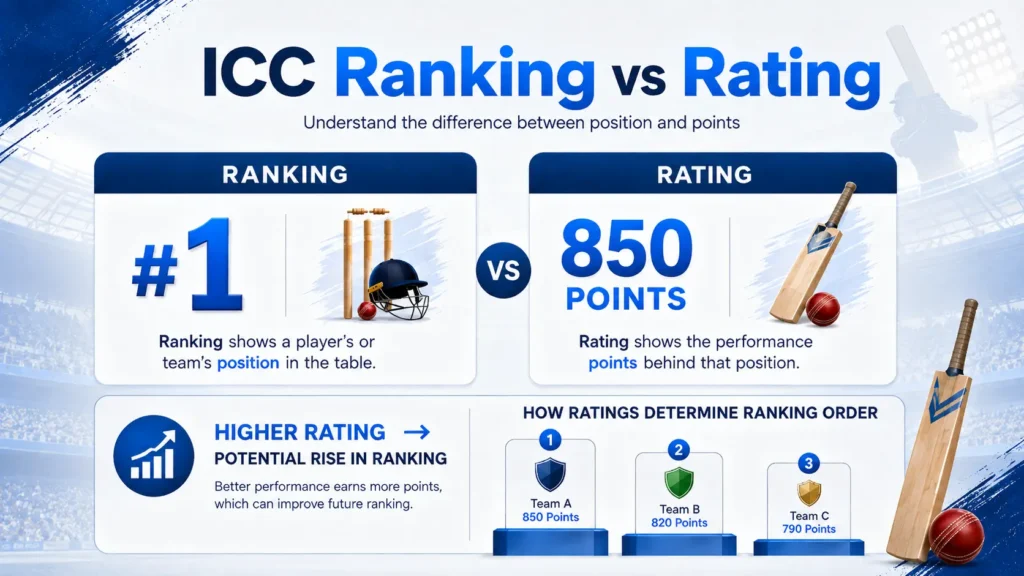
The rating points measure performance value.
The ranking position simply orders those players according to their current ratings.
If Player B improves from 830 to 845, they may still remain second.If they improve to 860 while Player A remains on 850, Player B could become No. 1.
ICC Rankings vs Tournament Standings
ICC world rankings should not be confused with tournament tables.
They measure different things.
ICC Rankings
Measure teams or players over a rolling period.
Tournament Standings
Measure performance within one specific tournament.
World Test Championship Standings
Operate under a competition-specific points system.
Net Run Rate
Acts primarily as a tournament performance/tie-breaking metric.
A team can therefore win a tournament without immediately becoming the world’s No. 1 ranked side.
Likewise, the No. 1 ranked team is not automatically guaranteed to win the next World Cup.Rankings measure sustained performance. Tournaments determine champions.
Why Are Test, ODI and T20I Rankings Separate?
Each cricket format demands different skills.
Test cricket rewards:
- long-term concentration;
- batting technique;
- sustained bowling pressure;
- endurance.
ODI cricket combines:
- innings management;
- strike rotation;
- controlled aggression;
- middle-over strategy.
T20I cricket places greater emphasis on:
- scoring rate;
- boundary hitting;
- economy;
- wicket-taking impact;
- short-term tactical execution.
Combining all three formats into one universal ranking would therefore make meaningful comparison difficult.ICC maintains separate rankings to measure players and teams within the competitive demands of each format.
Why Do ICC Rankings Matter?
ICC rankings offer a standardized way to compare international performance across countries.
They help fans and analysts understand:
- which teams are performing consistently;
- which batters are currently strongest;
- which bowlers are producing high-value performances;
- which all-rounders contribute substantially in both disciplines;
- how performance trends change over time.
Rankings may also be used as part of specific competition qualification or seeding arrangements when the relevant governing rules specify a ranking cut-off.
However, rankings should not be interpreted as a guarantee of future match results.Cricket remains influenced by conditions, opposition, player availability, team selection and match-day performance.
Common Myths About ICC Cricket Rankings
Myth 1: Rankings Are Based Only on Runs and Wickets
They are not.
Performance context, opposition quality and other match-related factors also contribute to player ratings.
Myth 2: ICC Experts Manually Rate Every Performance
They do not.
ICC says its player-ranking calculations are pre-programmed and involve no subjective human assessment.
Myth 3: One Great Innings Automatically Makes Someone No. 1
Usually not.
The system uses a moving-average approach, so sustained performance carries significant importance.
Myth 4: The Player With the Best Career Average Must Rank First
Not necessarily.
Career averages and ICC ratings answer different questions.
ICC describes its rankings as considering a player’s wider career while placing greater emphasis on recent performance.
Myth 5: A No. 1 Team Must Be the Current World Champion
No.
World championships are decided through tournaments.
Rankings measure performance over a rolling period.
Key Takeaways
The most important things to understand about how ICC cricket rankings work are:
- ICC maintains separate rankings for different international cricket formats.
- Ranking means table position; rating means points.
- ICC player ratings operate on a 0–1,000 scale.
- Recent performances receive greater importance than older performances.
- Opposition strength influences ranking value.
- Player calculations use an automated algorithm rather than subjective human assessment.
- Match scoring patterns help the system account for playing conditions.
- ICC does not publicly disclose every coefficient in its player-ranking algorithm.
- All-rounder ratings combine batting and bowling ratings.
- Team rankings undergo annual recency updates.
- Player rankings are updated weekly.
Rankings measure sustained international performance rather than guaranteeing future results.
Frequently Asked Questions About ICC Rankings
How are ICC cricket rankings calculated?
ICC team rankings use a points-and-rating system based primarily on results and relative team strength. Player rankings use an automated moving-average algorithm that evaluates international performances within each format.
What is the maximum ICC player rating?
ICC player ratings use a scale running up to 1,000 points. Ratings above 900 are extremely rare and represent exceptional performance.
Is 900 a good ICC rating?
Yes. ICC describes a rating above 900 as a supreme achievement that relatively few players reach.
How often are ICC rankings updated?
Men’s player rankings are normally updated on Wednesdays and women’s player rankings on Tuesdays. Team rankings are updated following relevant matches or Test series, with annual updates around May.
Does opposition strength affect ICC rankings?
Yes. ICC rankings account for opposition quality, meaning performances against stronger opponents can carry different value from performances against weaker opposition.
Does pitch difficulty affect ICC player rankings?
The system can account indirectly for playing conditions through scorecard information. ICC does not use a human panel to manually rate each pitch for ranking purposes.
Can an inactive player’s ranking fall?
Yes. Other players can overtake an inactive player, older performances can lose influence, and players eventually fall outside qualifying-period requirements if they do not play for long enough.
How are ICC all-rounder rankings calculated?
ICC calculates the all-rounder index by multiplying a player’s batting rating by their bowling rating and dividing the result by 1,000.
Are ICC rankings the same as World Cup standings?
No. ICC rankings measure performance across a rolling period, while World Cup standings apply only to matches and rules within a specific tournament.
Are ICC player ranking formulas public?
ICC publicly explains the major principles and several factors used in its rankings, but it describes the player calculation as a sophisticated algorithm and does not publish every underlying coefficient required to independently reproduce every rating exactly.
Conclusion
ICC cricket rankings are more sophisticated than simple tables of runs, wickets or wins.
ICC team rankings evaluate international results over a rolling period while accounting for the relative strength of competing teams. ICC player rankings use format-specific algorithms to evaluate individual performances, emphasizing recent results while retaining information from a player’s wider career.
Understanding the difference between ranking position and rating points, along with factors such as opposition strength, recent performance, inactivity and match conditions, makes movements in the ICC tables much easier to interpret.For the most accurate current positions, always refer to the official ICC World Rankings, since team and player ratings change as new international matches are completed.